Full-Body Exercises | Full-Body Workouts | Full-Body Dumbbell Workouts | Full-Body Workouts At Home | Bowflex Home Gym | Best Functional Trainers
Time is one of the biggest hindrances to strength training. The traditional wisdom of muscle isolation, muscle hypertrophy, and splits requires massive amounts of time, and that can be a turn-off, particularly if strength training isn't the main goal of your fitness routine. However, strength training can be beneficial for weight loss and improving performance in other fitness areas like endurance training. So what should you do? Enter full-body workouts.
Full-body workouts are exactly what they sound like: workouts that target all of the body's major muscle groups in a single session rather than isolating muscle groups and rotating training days. During a full-body workout, there are primary muscles that each movement is working, but these moves are also dynamic and require secondary muscles to act as stabilizers. These workouts are flexible and can be performed as full-body circuit routines, or with a variety of equipment like BOSU balls, TRX systems, kettlebells, or full-body workout machines, or no equipment at all.
Benefits of Full-Body Workouts
Full-body workouts are designed to challenge your whole body in one session as opposed to more traditional splits which target specific muscle groups (such as chest or abs) on different days. However, full-body workouts are by no means a compromise. If you use the workouts correctly, you will see the strength results you are looking for. In fact, studies show that complex movements—a concept we will be basing most of our full-body workouts on—are just as effective for muscle growth as isolating movements that only target your mirror muscles.
Complex movements may sound intimidating, but you don’t need to be a fitness expert to perform these exercises. To perform a complex movement you simply need to use more than one joint during the movement. You are performing a complex movement when you do supersets like bench presses and rows with minimal rest in between. You are also doing complex movements when you do a single movement like a power clean because you’re engaging most of the joints in your legs, hips, elbows, and shoulders at the same time.
There are several benefits to training this way. Full-body workouts typically last 30-45 minutes and require more dedicated intensity than traditional isolation splits. And because you are working all of the major muscle groups in a full-body workout session, you need to give your body more time to recover which means a good full-body workout plan will limit you to three or four days per week.
Speaking of recovery, full-body workouts also give your body a higher lactic acid threshold, which is just another way of saying you’ll be able to work out with high intensity for a longer period of time.
Who Should Do Full-Body Workouts
Full-body workouts are perfect for people who don't want to go to the gym five or six days per week. The 6-Week Full-Body Workout Plan included in this article only requires you to go to the gym three days per week for 45-minute sessions (including your warm-up). A manageable time commitment, right?
Full-body workouts are also great for endurance athletes who have other fitness goals that require training. For example, a long-distance runner will benefit from strength training, but cannot typically afford to spend five days in the gym on a traditional split routine. Because of this, there is a temptation for endurance athletes to sacrifice their strength training in order to practice their sport. Full-body workouts allow athletes to build strength while also leaving the majority of their time open to dedicating themselves to their sport.
So what's next? If you want to take the plunge into full-body workouts, we’ve compiled a list of possible supersets and complex movements to incorporate into your routine either at home (if you have the equipment) or in the gym. At the end of that list is a six-week plan built to help you get started in full-body training.
Full-Body Workout List
When thinking about what to include in a full-body workout plan, you have to take stock of the equipment you have access to. We’ve made it easy and grouped our workout recommendations by equipment type. If you are putting together a workout plan from these exercises and want to mix and match, you are welcome to do so. The more comfortable you get performing full-body workouts, the more you should be able to adjust to what works best for your body.
Weights: Workout A
First, let's talk about a full-body workout using traditional weights. This equipment is easily accessible at any gym, but also would be a great place to start if you're trying to build a home gym. The movements on this list are designed with the maximum customization in mind.
Pro tip:If you're an endurance athlete who wants to increase the aerobic quality of your strength training, try combining the sets below into supersets.
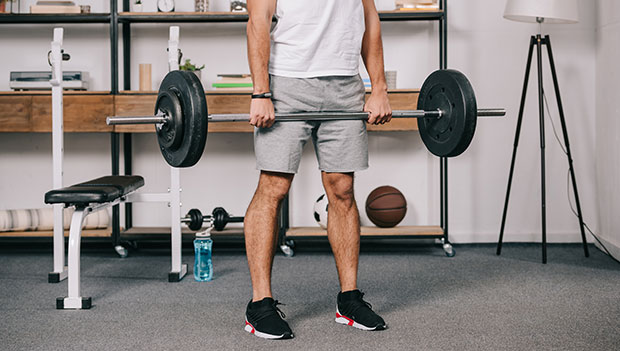
Set 1: Deadlift - 4 sets of 6 reps
- Start with the barbell on the ground. Squat down and grip the bar with your hands about shoulder-width apart.
- With your heels on the floor, head and chest up, and your shoulders back, lift the bar into a standing position. Pause when the bar is around thigh level.
- Maintain control of the weight and return to the starting position where you will pause before repeating the motion.
Pro tip:Make sure to hinge at the hips instead of going into a full squat. Bent knees are fine but you don’t want too much of the load transferring through your quadriceps.
Primary Muscles Worked: hamstrings, glutes, hips, lower back, core
Set 2: Power Clean - 4 sets of 6 reps
- Start with the barbell on the ground. Squat down and grip the bar with your hands about shoulder-width apart.
- With your heels on the floor, your head and chest up, and your shoulders back. Lift the weight to about thigh level.
- In an explosive movement, flip the weight up into a front rack position with the bar resting on your shoulders and your elbows up.
- Return the weight to the starting position in a controlled manner.
Primary Muscles Worked: hamstrings, hips, glutes, core, lower back, traps, shoulders
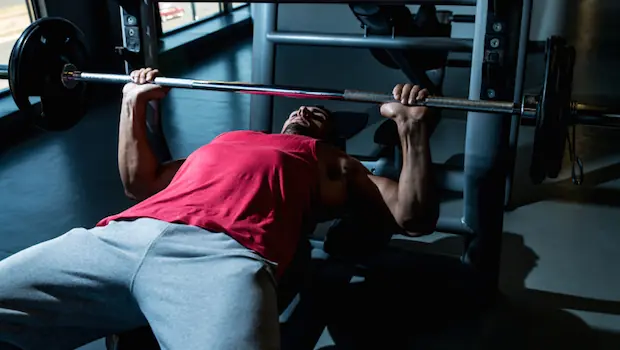
Set 3: Bench Press - 4 sets of 6 reps
- Start by lying on a bench with the weight racked over your chest. Grip the bar with your hands shoulder-width apart and lift the weight off the rack.
- Lower the weight slowly and with control until the bar touches your chest. Keep your elbows in as you lower.
- Drive the weight back up away from your chest until your arms are locked out.
Primary Muscles Worked: chest, triceps, shoulders
Set 4: Barbell Row - 4 sets of 6 reps
- Start with the barbell on the ground in front of your shins. Your feet should be shoulder-width apart and your grip on the bar should also be about shoulder width.
- Hinge at the hips to bend over slightly. Keep your back flat and head up.
- Pull the bar up until you make contact with your lower chest. Your elbows should be tucked.
- Lower the bar back to the starting position in a controlled manner.
Pro tip:Don't shrug your shoulders during this movement. Keep your core tight and shoulders down.
Primary Muscles Worked: upper back, lower back, core, arms
Machines: Workout B
Machines are typically associated with muscle isolation, but don’t be afraid to use them in your full-body workout, too. Machines are a great way to challenge your major muscle groups and your cardiovascular system simultaneously. In the following workout, play around with the rest time between sets to really challenge yourself.
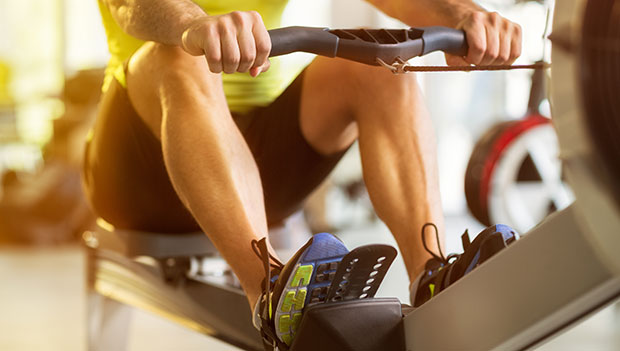
Set 1: Rowing Machine - 4 sets of 60 seconds
- Sit on the row machine and lock your feet in place as labeled.
- Push back with your feet while pulling the handle toward your torso.
- Return to the starting position and repeat the motion for 60 seconds before taking a break.
Primary Muscles Worked: quads, hamstrings, glutes, core, arms, chest, upper back, lower back
Set 2: Assisted Dip - 4 sets of 6 reps
- Select a weight on the machine that is challenging for you.
- Press your body up until your arms are locked out and your feet are suspended above the ground.
- Slowly lower your body down until your arms are parallel to the floor.
- Press back up to the starting position.
Primary Muscles Worked: triceps, chest, upper back, core, biceps, forearms
Set 3: Hamstring Curl - 4 sets of 6 reps
- Select a weight that is challenging.
- Lie face down and put your legs on the machine as indicated.
- Curl your feet toward your torso.
- Pause when your feet touch your glutes before lowering back to the starting position.
Primary Muscles Worked: hamstrings, calves, core
Set 4: Leg Extension - 4 sets of 6 reps
- Choose a weight on the machine that is challenging.
- Extend your legs until they are locked out.
- Pause before returning to the starting position in a slow and controlled manner.
Primary Muscles Worked: quads, hips, core
Set 5: Treadmill Run - 4 sets of 2-min. sprints, 30 sec. of rest (10 min. total)
- On the treadmill, find a challenging running pace you can sustain for 2 minutes.
- Run for 2 minutes, then walk for 30 seconds. Repeat four times.
Primary Muscles Worked: glutes, hamstrings, quads, hips, calves, core, lower back
TRX: Workout C
TRX systems allow you to manipulate your body position which allows you to increase or decrease the difficulty of different bodyweight movements according to your ability. They are a versatile tool available at many gyms and they’re a relatively affordable option if you prefer working out at home. If you find that an exercise on this list is too difficult or too easy, TRX has plenty of resources online to help you adjust.
Set 1: TRX Row - 3 sets of 8 reps
- Make sure both handles of the TRX system are even. Holding one in each hand, move your body into a “leaning back” position where your legs and arms are fully extended.
- Keeping your core tight, pull your body up until your chest touches the handles. Your elbows should remain tucked throughout the movement.
- Lower your body back to the starting position in a controlled manner.
Primary Muscles Worked: upper back, lower back, core, arms
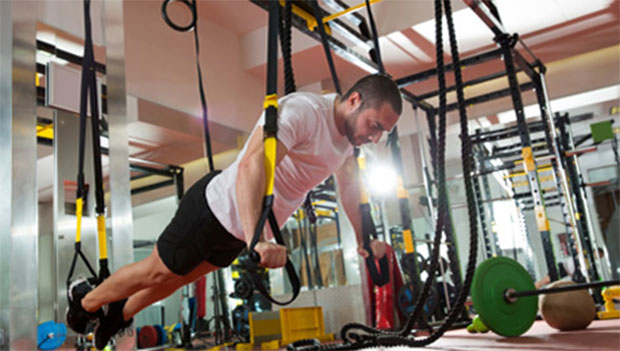
Set 2: TRX Push-up - 3 sets of 10 reps
- Make sure both handles of the TRX system are even. Holding one handle in each hand, move your feet until your body is leaning forward to your comfort level.
- move your feet until your body is leaning forward to your comfort level. Perform a push-up motion, maintaining control of your body. Keep your core tight throughout the entire movement.
Pro tip:The more advanced you are, the closer to parallel your body should be to the ground.
Primary Muscles Worked: chest, shoulders, triceps, forearms, core
Set 3: TRX Plank - 3 sets of 20-30 seconds
- Position the TRX handles several inches above the floor. On your hands and knees, put your foot in the handles and use them as stirrups.
- When your feet are secure, walk your hands away from them until your body is in a plank position.
- Hold the plank position for the allotted time. To disengage, first lower your knees to the floor then walk your hands back until you can comfortably remove your feet from the TRX system.
Pro tip:A good plank position is back flat, core tight, and head in a neutral position with your shoulders stacked directly above your hands.
Primary Muscles Worked: core, shoulders, arms, hips, quads, hamstrings
Set 4: TRX Squat - 3 sets of 10 reps
- Position the TRX handles at chest height and grab one handle with each hand. Your feet should be shoulder-width apart.
- Keeping your head and chest up, perform a deep squat (as low as you can go) using the TRX system for balance only.
- Return to the starting position.
Primary Muscles Worked: hamstrings, glutes, quads, core
Circuit Workout: Workout D
Circuits combine strength training and cardio training into one short—but intense—workout. Perform each movement in this workout for the time listed, then immediately move on to the next exercise. You can adjust the difficulty by adding weight or increasing the speed of the movement.
Repeat the circuit a total of 6 times. Take breaks as needed and rest 30-60 seconds between rounds.
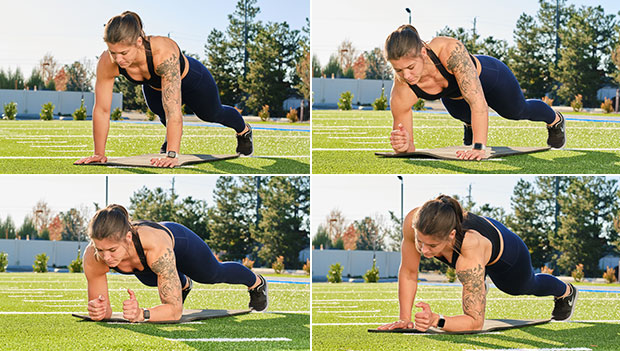
Set 3: Set 1: Plank Up-Down - 6 sets of 30 seconds
- Start in a straight-arm plank position with your body in a straight line. Your hands should be on the ground, slightly wider than shoulder-width apart. Your back should be flat and your head neutral.
- Keep your core tight and lower yourself onto one elbow, then the other, until you are resting on your elbows and forearms.
- Push your body back up one elbow at a time to the starting position.
Pro tip:Keep your shoulders slightly in front of your hands to relieve the pressure on your elbow joints and spread the load to the right muscle groups.
Primary Muscles Worked: chest, arms, core, glutes, quads
Set 2: Walking Lunge - 6 sets of 30 seconds
- Start with your feet shoulder-width apart. Take a big step forward with one foot.
- Lunge your body down until your back knee touches the floor.
- Pushing off with your back foot, step it forward in line with your front foot.
- Repeat the motion on the other side, alternating legs each rep, until the time is finished.
Primary Muscles Worked: hamstrings, glutes, quads, calves, hips, core, lower back
Set 3: Inverted Row - 6 sets of 30 seconds
- Position a barbell in a secured rack, fairly close to the floor.
- Grip the barbell from underneath and walk your feet away until your body is straight.
- Squeeze the bar with your hands and pull your chest toward the bar. Keep your core tight and shoulders back for the duration of the movement.
- Lower yourself back to the starting position in a controlled manner.
Primary Muscles Worked: upper back, lower back, core, arms
Set 4: Assisted Pistol Squat - 6 sets of 30 seconds
- Start in a standing position with your feet slightly wider than shoulder-width apart. Have a support within arm's reach.
- Keeping your core tight and chest and head up, lower into a squat position on one leg. The other leg should be lifted off the ground and extended in front of your body. Use the support as necessary to complete the move.
- Drive through your foot until you are back in the starting position. Repeat the movement with the other leg.
Primary Muscles Worked: hamstrings, glutes, quads, calves, core, lower back
Resistance Bands: Workout E
Resistance-band workouts offer the ultimate flexibility. If you want to make an exercise more difficult, simply switch out the band for a stronger one and perform the same movement. Resistance bands are available in most gyms and are a very inexpensive investment to use at home.
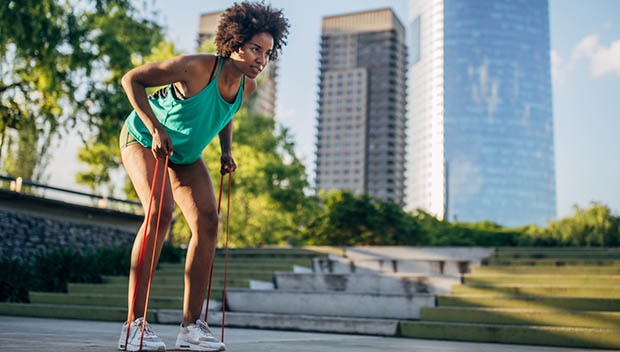
Set 1: Lateral Band Walk - 3 sets of 10 reps per side
- Place a resistance band just above your knees and start with your feet about shoulder-width apart. Keep your core tight and torso straight throughout the movement.
- Bend your knees slightly in an athletic stance that tenses your muscles. Take a small step to your right, leading with your right foot.
- Step your left foot in to return to the athletic position before taking another step out with your right foot.
- Repeat until you’ve completed all reps on the right side, then repeat the whole sequence on the left side.
Primary Muscles Worked: glutes, hips, thighs
Set 2: Band Squat - 3 sets of 10 reps
- Place the resistance band just above your knees and start with your feet about shoulder-width apart. Keep your core tight and torso straight throughout the movement.
- Hinge your hips back until you are in a seated position with your thighs at or below parallel to the ground.
- Press through your heels to return to the starting position.
Primary Muscles Worked: glutes, quads, hips, core, lower back
Set 3: Bent-Over Band Row - 3 sets of 8 reps
- Stand on a portion of the resistance band and keep your feet about shoulder-width apart. Hold one end of the resistance band in each hand.
- Slightly bend your knees and lean forward, hinging at the hips. Keep your core tight and your chest and head up.
- Keeping your elbows tucked, pull the band toward your chest while squeezing your shoulder blades together.
- Lower the band slowly and with control back to the starting position.
Primary Muscles Worked: upper back, lower back, shoulders, arms, core
Set 4: Standing Band Curl - 3 sets of 8 reps
- Stand on the middle of a resistance band and keep your feet about shoulder-width apart. Hold one end of the resistance band in each hand with an underhand grip.
- Curl the band toward your shoulders.
- Keeping your elbows tucked, pull the band toward your chest while squeezing your shoulder blades together.
- Lower the band slowly and with control back to the starting position.
Primary Muscles Worked: biceps, core
Set 5: Band Triceps Extension - 3 sets of 8 reps
- Start with your feet in a staggered position, with one slightly in front of the other. Tuck the resistance band under the back foot and hold the other end in both hands behind your head with your elbows pointed at the ceiling.
- Keeping your elbows stationary, lift your hands until they are fully extended above your head.
- Return to the starting position in a slow and controlled manner.
Primary Muscles Worked: triceps, shoulders, upper back
6-Week Full-Body Workout Plan
The following six-week workout plan is designed using the workout suggestions above. You can rearrange workouts depending on your preferences without fear of throwing your strength training off balance because each workout is designed to work your entire body.
The plan will ask you to work out three days per week with a fourth optional workout. It is up to you what days you work out, but we recommend taking at least one rest day between. The weight and resistance level of each exercise will depend on your strength and experience level. A good rule of thumb is to use enough weight where you can complete the set and have the energy for another 2-3 reps after each set.
Week 1
- Day 1: Workout A
- Day 2: Workout B
- Day 3: Workout C
- Optional Day 4: Workout E
Week 2
- Day 1: Workout B
- Day 2: Workout D
- Day 3: Workout A
- Optional Day 4: Workout C
Week 3
- Day 1: Workout A
- Day 2: Workout B
- Day 3: Workout C
- Optional Day 4: Workout E
Week 4
- Day 1: Workout B
- Day 2: Workout D
- Day 3: Workout A
- Optional Day 4: Workout C
Week 5
- Day 1: Workout E
- Day 2: Workout A
- Day 3: Workout B
- Optional Day 4: Workout D
Week 6
- Day 1: Workout B
- Day 2: Workout C
- Day 3: Workout D
- Optional Day 4: Workout A
Final Takeaway
Don't be afraid to adjust the order of these workouts to your preference. One of the best parts of full-body workouts is that you never have to worry about overloading one muscle group to the exclusion of another. All of the workouts on our list can be mixed and matched to train all of the major muscle groups in one session. We encourage you to experiment to find not only what works best for you, but what you actually enjoy doing. The more fun you have in your workouts the more likely you are to stick with them.
Full-Body Exercises | Full-Body Workouts | Full-Body Dumbbell Workouts | Full-Body Workouts At Home | Bowflex Home Gym | Best Functional Trainers
Get ACTIVE on the Go


Couch to 5K®
The best way to get new runners off the couch and across the finish line of their first 5K.
Available for iOS | Android





Discuss This Article